The funeral of a president is a solemn national occasion that honors a leader who served as both head of state and symbol of the nation. It typically includes ceremonial elements such as military honors, official processions, and moments of reflection attended by current and former leaders, foreign dignitaries, and the public.
Beyond commemorating an individual life, a presidential funeral offers the country a moment to reflect on the legacy of leadership, the peaceful transfer of power, and the enduring strength of the democratic institutions the president upheld.
When should bells ring for the state funeral for a president?
At the occasion of a state funeral, bells resound to pay last respects to a sitting or former president, or a president-elect. Given the national significance and heightened security arrangements of a state funeral for a president, bell ringing for the commemorations is tightly choreographed. However, this guidance may be altered, subject to the wishes of the bereaved family.
Presidents and their families select the location for their own funeral, which may be a location other than Washington National Cathedral. Some have more than one funeral, electing to have the state funeral in Washington, D.C., followed by a more private funeral near their home or place of burial.
NATIONWIDE
- 63 minutes before funeral
Following a prelude of pieces appropriate to the occasion, carillons, chimes of suitable range, and handbell ringers may play “Hail to the Chief” in an arrangement of their choosing.
- 60 minutes before funeral
Tower bells should be tolled once a minute. The total number of tolls is equal to that of their number in the line of presidencies, e.g. 41 times for George H.W. Bush, the 41st president. Change ringers may elect to ring a quarter peal, fully muffled.
- 5 minutes before funeral
Bells cease ringing to align with a nationwide moment of silence.
WASHINGTON, D.C.
-
When the cortège departs the U.S. Capitol
The bourdon at Washington National Cathedral begins tolling once a minute. The total number of tolls is equal to that of their number in the line of presidencies, e.g. 41 times for George H.W. Bush, the 41st president. This corresponds with the timed arrival of the cortege to the funeral location.See also: Lying in State / Lying in Honor
As the hearse carrying the body makes its way through the city, muffled bells along the route to the church should toll solemnly at 7-second intervals, beginning when the lead car (most often a police escort) passes in front of the structure and continuing until the last car in the procession passes by. The bourdon or deepest-tone bell should be chosen for this tolling.
Bells located at sites other than along the cortege route may follow the nationwide ringing guidelines above.
-
When the cortège arrives at the funeral location
A bell in the mid-range (not the bourdon) at the location of the funeral service (or, in the absence of a bell on-site, a bell nearest to the site) will strike resolutely three times as the door to the hearse is opened – the last National Salute rendered.Bells will remain silent as the procession enters the church.
- Following the service
When the door to the hearse is closed and ready for departure, change ringers at or near the location of the funeral service may elect to begin a quarter peal, fully muffled.
- When the cortege departs the funeral location
As the hearse carrying the body makes its way through the city, muffled bells along the route to the burial ground should toll solemnly, beginning when the lead car (most often a police escort) passes in front of the structure and continuing until the last car in the procession passes by.
LOCATION OF BURIAL
- In order to effect a solemn and dignified atmosphere, bells will remain silent during the burial.
What is the historical context for this bell ringing schedule?
This bell ringing guidance was assembled from loosely-woven American traditions and the protocols of our closest allies, most notably the United Kingdom. It must be reiterated that presidents and their families put their own imprint on these funeral preparations and select the location for their own funeral, which is not always at Washington National Cathedral. For instance, the funeral of John F. Kennedy was held at the Cathedral of St. Matthew the Apostle, and the funeral of Lyndon B. Johnson took place at National City Christian Church. Other historical miscellany informing this guidance include:
- A pilot train ran about 30 min. ahead of the funeral train that crossed the nation to announce the arrival of Lincoln’s body by sounding a half-muffled bell.
- For George H.W. Bush’s state funeral in Washington, D.C., Washington National Cathedral’s bourdon sounded 41 times as the cortège moved from the U.S. Capitol to the Cathedral.
- The bell at the Cathedral of St. Matthew the Apostle tolled solemnly as Jackie Kennedy walked the six blocks from the White House to the funeral service. This was poignantly captured by novelist and poet Robert Hazel, who composed a poem entitled “Riderless Horse” following the day’s events, which included the line: “Your widow stalks your body through an avenue / of bare sycamores, and one answering bell, / leading heads of state to altar and precipice.”
- During preparations for President Reagan’s state funeral, Washington National Cathedral’s worship department staff discussed ringing the age of the deceased. It was disclosed in a staff meeting that when this was proposed to Nancy Reagan, she replied that rather than ringing his age, it would be more appropriate to toll the bourdon 40 times because Ronald Reagan was the 40th president. This has remained the Cathedral’s custom for state funerals for presidents.
- President Reagan’s tolling occurred at the conclusion of the service, the bourdon tolling 40 consecutive strokes, whereas the tolling was moved prior to the service for Presidents Ford and H.W. Bush. In all three services, the tolling was performed by the resident carillonist, as the bourdon bell is a component of the carillon.
- For President Ford’s state funeral, the tolling began when the funeral cortège left the U.S. Capitol for Washington National Cathedral. The bourdon tolled once a minute for 38 times and the cortège was timed to arrive at the cathedral in 38 minutes. The custom was repeated for the state funeral of President H.W. Bush, the bourdon ringing 41 strokes, and the cortège arriving at the cathedral in 41 minutes. Prior to the tolling, a carillon prelude of religious and patriotic music was performed by the carillonist for the state funeral of President Bush.
- At the death of Her Late Majesty, Big Ben tolled every minute for 96 minutes – once for every year of the life of Queen Elizabeth II.
- A note on "Hail to the Chief": Association with the president first occurred in 1815, when it was played to honor both George Washington and the end of the War of 1812 (under the name "Wreaths for the Chieftain"). By the 10th presidency, Julia Tyler, second wife of John Tyler, requested its use to announce the arrival of the president. As established at George H.W. Bush’s funeral, the song is also played during a former president's state funeral after the casket is removed from the hearse.
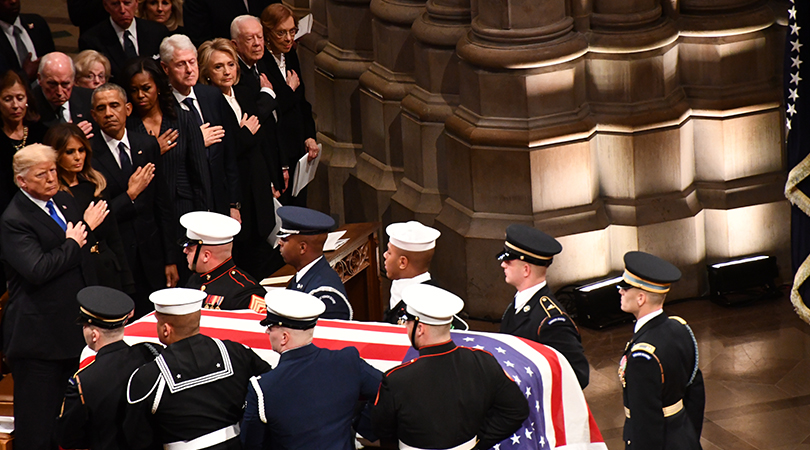
Cover image: The coffin of President George H.W. Bush passes before a row of former presidents during funeral services at Washington National Cathedral on Dec. 6, 2018.