Reserved for any person afforded official funerary rites conducted by the federal government in Washington, D.C., a state funeral honors high government officials and civilians who have rendered distinguished service to the nation, reflecting the nation’s gratitude for their service. At these moments, bells resound in deference to pay last respects.
Typically marked by military honors, official processions, and moments of public remembrance, a state funeral brings together government officials, foreign dignitaries, and citizens in a shared act of mourning. Beyond paying tribute to an individual life, it serves as a solemn expression of national unity, continuity, and acknowledgment of the institutions and values the honoree represented.
When should bells ring for a state funeral?
Given the national significance and heightened security arrangements of a state funeral, bell ringing for the commemorations is tightly choreographed. However, this guidance may be altered, subject to the wishes of the bereaved family.
NATIONWIDE
- 60 minutes before funeral
Carillons, chimes of suitable range, and handbell ringers may play a prelude of pieces appropriate to the occasion. Change ringers may elect to ring a quarter peal, half muffled.
- 5 minutes before funeral
Bells cease ringing.
WASHINGTON, D.C.
-
When the cortege departs the U.S. Capitol
As the hearse carrying the body makes its way through the city, half-muffled bells along the route from the U.S. Capitol to the church should toll solemnly, beginning when the lead car (most often a police escort) passes in front of the structure and continuing until the last car in the procession passes by. The bourdon or deepest-tone bell should be chosen for this tolling.See also: Lying in State / Lying in Honor
Bells located at sites other than along the cortege route may follow the nationwide ringing guidelines above. Bells will remain silent as the procession enters the church.
- Following the service
When the door to the hearse is closed and ready for departure, change ringers at or near the location of the funeral service may elect to begin a quarter peal, half muffled.
- When the cortege departs the funeral location
As the hearse carrying the body makes its way through the city, half-muffled bells along the route to the burial ground (or, in the case of an out-of-state burial, to Joint Base Andrews or the designated airport) should toll solemnly, beginning when the lead car (most often a police escort) passes in front of the structure and continuing until the last car in the procession passes by.
LOCATION OF BURIAL
- In order to effect a solemn and dignified atmosphere, bells will remain silent during the burial.
What is the historical context for this bell ringing schedule?
During Senator John McCain’s funeral, a carillon prelude was performed, without tolling when the cortège traveled from the U.S. Capitol to Washington National Cathedral. It was explained that tolling once a minute from the Gloria in Excelsis bell tower was reserved for presidents of the United States.
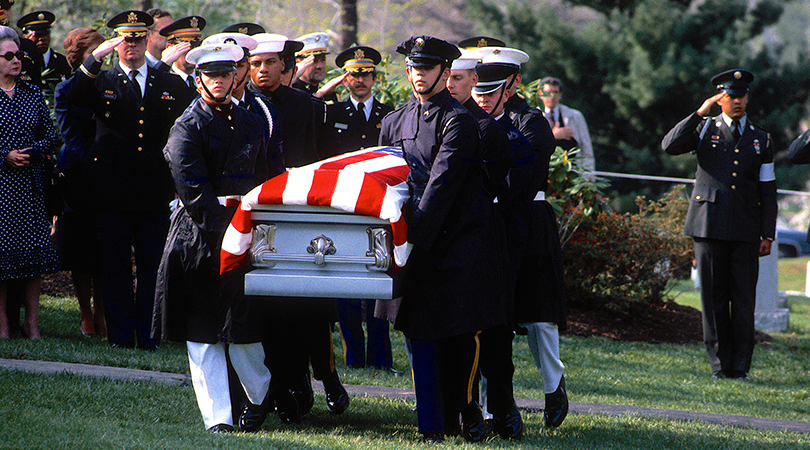
Cover image: A funeral detail carries the casket of General of the Army Omar Bradley to the gravesite at Arlington National Cemetery following a state funeral and grand military ceremony honoring him as the last of the five-star generals on April 14, 1981.