Community tragedies, such as mass shootings, air and space accidents, or sudden environmental disasters, can leave a deep and lasting impact on not only those directly affected, but the wider region, as well. These events often shatter a sense of normalcy, bringing grief, fear, and uncertainty to families, neighbors, and the nation itself.
In the aftermath, people may struggle to process loss while searching for answers and ways to support one another. At the same time, such moments frequently reveal the resilience of communities, as individuals come together to mourn, offer help, and reaffirm shared values of compassion, resilience, and care for one another in the face of profound loss. At such times, the familiar resonance of bells may uplift, unite, and inspire.
When should bells ring after a community tragedy?
Bells may be half-muffled and generally rung at sunset on the first Saturday following a tragedy affecting a national, state, or local community. Alternatively, where bell ringing is common at this time, it may be more suitable for bells to remain silent in a moment of deference to those impacted.
Suggested action includes a peal, quarter peal, or general ringing of up to 45 minutes, as able. Carillons, chimes of suitable range, and handbell ringers may play a recital of dirges and hymns appropriate to the occasion.
How do we define a community tragedy?
Local events of importance may be determined and coordinated by the presiding municipality. For national commemorations, the U.S. Bell Command provides guidance in alignment with official presidential proclamations issued under authority from the U.S. Flag Code (Title 4 & 36 of the U.S. Code).
A national tragedy might include, but is not limited to:
- A violent crime in which one or more attackers kill or injure multiple individuals simultaneously
- A significant casualty event involving members of the Armed Forces, whether in training or combat
- An incident involving a manned mission to space resulting in the death of astronauts
- The sinking of a ship with multiple passengers onboard
U.S. statute (the Investigative Assistance for Violent Crimes Act of 2012) defines a mass killing as “3 or more killings in a single incident,” with the distinction that the shooter or perpetrators are not included in any fatality statistics.
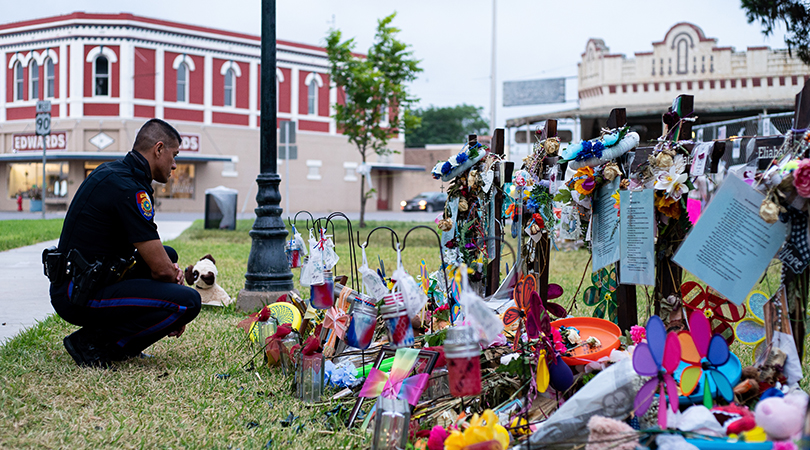
Cover image: A police officer from Edinburg, Texas, visits the memorial for Robb Elementary School victims in Uvalde, Texas, on June 9, 2022.